
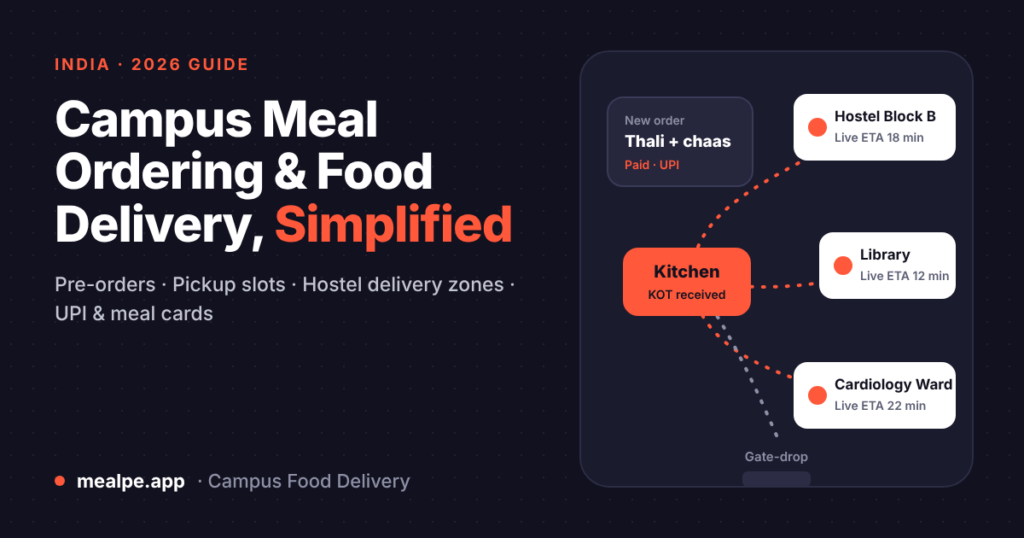
Campus meal ordering lets students, faculty and staff order from campus messes, canteens, cafés and nearby restaurants on a phone, pay digitally, and collect at a chosen time or receive delivery on campus. India has 4.50 crore higher-education students (AISHE 2023-24), yet campus food still runs largely on queues, cash and gate rules. Hunger keeps a tighter timetable than any lecture. This guide explains how campus meal ordering and intra-campus delivery work in India, what they cost, and what a 3,000-student campus gains.
Key takeaways
- Campus meal ordering replaces queues with pre-orders, pickup slots and zone-based delivery to hostels, wards and labs.
- Security decides who delivers: in May 2025, IIT Bombay restricted outside delivery agents to 6:00 AM–11:00 PM, so closed-loop intra-campus delivery keeps food moving without opening gates.
- Swiggy and Zomato platform fees hit ₹17.58 per order including GST in March 2026; on a campus-first platform, the institution sets fees.
- Worked example: moving 600 evening orders to 10-order runs by campus agents cuts outsider gate entries from up to 600 to zero.
In this guide
- What is campus meal ordering?
- Why does campus food ordering get chaotic?
- How does it work for students?
- How does intra-campus delivery work for institutions?
- Campus-first platform vs aggregator apps vs counters
- Worked example: a 3,000-student campus
- Checklist for choosing a platform
- MealPe availability and go-live
- FAQs
What is campus meal ordering?
MealPe | Table of Contents
Campus meal ordering is a digital system that lets students, faculty and staff order food from campus messes, canteens, cafés and nearby restaurants on a phone, pay in the app, and collect at a chosen time or receive delivery at a mapped location such as a hostel block, ward or lab.
Also called campus food ordering or canteen pre-ordering, it fits any closed campus that feeds people at scale: universities, residential colleges, hospitals, IT parks, SEZs and factories. India’s higher-education network alone registered 1,289 universities, 48,246 colleges and 15,221 standalone institutions in AISHE 2023-24.
| Attribute | Details |
|---|---|
| Definition | App-based ordering, payment and fulfilment of meals inside a closed campus |
| Order modes | Pre-order, scheduled pickup, dine-in, takeaway, intra-campus delivery, gate-drop |
| Payment modes | UPI, cards, wallets, prepaid campus balances, meal cards, meal subsidies |
| Fulfilment points | Outlet counters, hostel and office pick-points, mapped delivery zones |
| Used by | Universities, residential colleges, hospitals, IT parks and SEZs, factories |
| Related MealPe products | Campus Food Delivery, Digital Cafeteria, Mess Manager, Pre-Paid Meal Cards |
Campus meal ordering at a glance
Why does campus food ordering get chaotic?
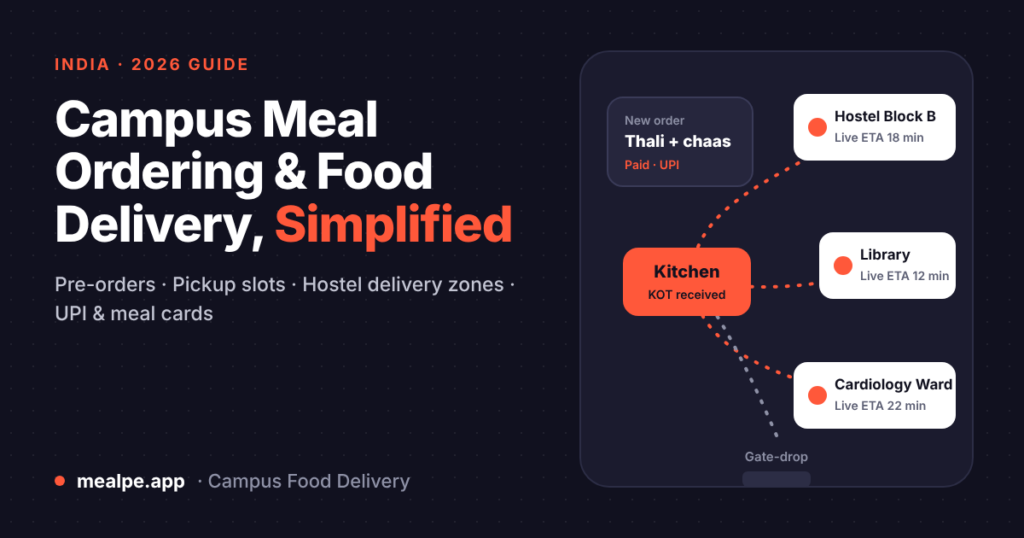
Campus food ordering gets chaotic because demand arrives in short bursts between classes, counters serve one order and one payment at a time, weather and distance stretch every trip, and security rules restrict outside riders, while kitchens cook to guesses instead of confirmed headcounts. Each problem has a specific digital fix.
| Problem | Root cause | Digital fix |
|---|---|---|
| Queues at every break | Demand peaks in one short window; counters serve one order at a time | Pre-orders and pickup slots |
| Weather and distance | Rain, heat and long walks on large campuses | Delivery to hostel blocks and pick-points |
| Limited payment options | Cash-only counters, change shortages | UPI, cards, wallets, prepaid balances |
| Gate restrictions | Entry windows, bag checks, hostel entry bans | Campus agents; gate-drop for outside orders |
| No admin visibility | Orders over calls and WhatsApp; cash disputes | Live dashboard of orders, ETAs and demand |
| Food waste | Kitchens cook buffers for unknown turnout | Headcounts from pre-orders and opt-outs |
Six campus food problems and their digital fixes
Security rules are tightening. In May 2025, IIT Bombay limited food and quick-commerce delivery agents to 6:00 AM–11:00 PM, with later orders collected at the gate and suspicious bags inspected (Insight, IIT Bombay). In October 2025, Nagpur’s Indira Gandhi Government Medical College and Hospital (IGGMCH) stopped delivery agents at the security post outside its hostels (Careers360).
Waste is just as measurable. A food-waste report from Amrita Vishwa Vidyapeetham’s Amritapuri campus, published in October 2025, logged 120 kg of waste a day in a mess serving 3,000 meals and found kitchens cooking extra as a buffer for unpredictable turnout (Amrita Vishwa Vidyapeetham).
UPI processed 25.47 billion transactions worth ₹31.53 lakh crore in October 2026 (NPCI data via IANS), so a cash-only counter asks students to carry money they no longer carry.
How does campus meal ordering work for students?
For students, campus meal ordering works in five steps: choose a location, browse live menus, pick pickup or delivery, pay in the app, and track the order. Placing an order takes seconds, the kitchen receives it the moment payment clears, and the full price, including any delivery fee, shows before payment.
- Choose your location: hostel block, department or office tower. The app shows only the outlets, windows and fees for that zone.
- Browse live menus: curated messes, canteens, cafés and cloud kitchens, with real-time availability, dietary tags, allergen filters, nutrition information and ratings from recent orders.
- Pick pickup or delivery: collect now, book a later slot, get delivery to your zone, or use a gate-drop for restaurants near campus. Group orders let a floor or lab order together.
- Pay in the app: UPI, a card, a wallet or your campus prepaid balance.
- Track and collect: a live ETA follows the order to the counter, pick-point or your door. Honest ETAs beat optimistic ones: 20 minutes promised and 18 delivered beats 10 promised and 25 delivered.
Key campus delivery terms
- A delivery zone is a predefined campus location, such as “Hostel Block B”, that sets which outlets, windows and fees apply.
- A pick-point is a fixed collection spot inside a hostel or office building.
- A gate-drop is a handover point at the campus gate for orders from outside restaurants, so outside riders never enter.
- Batch scheduling groups orders for the same zone and time window into one delivery run.
MealPe is private by default: students can hide orders on shared devices and manage data-rights requests in one place.
How does intra-campus food delivery work for institutions?
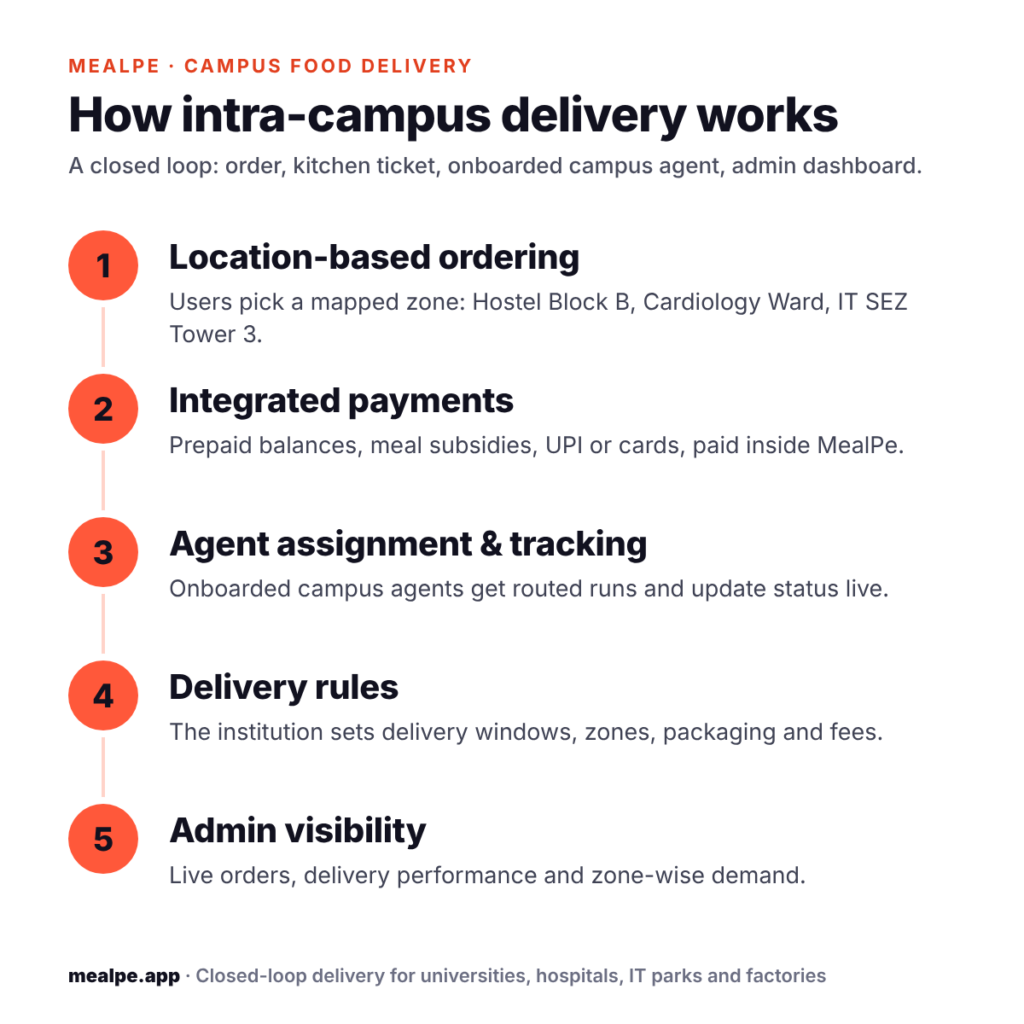
Intra-campus food delivery is a closed-loop model: users order in the MealPe app, the kitchen receives a KOT (kitchen order ticket) instantly, and onboarded campus agents fulfil each order through a tracked workflow. The institution sets zones, delivery windows, fees and building access, so no external rider has to pass the gate.

- Location-based ordering. Users pick a predefined zone, such as “Hostel Block B”, “Cardiology Ward” or “IT SEZ Tower 3”, and menus, delivery options and pricing filter to it.
- Integrated payments. Orders are paid inside MealPe with prepaid balances, meal subsidies, UPI or cards; no external app is involved.
- Agent assignment and tracking. Internal agents receive routed assignments and update status in real time until handover.
- Delivery rules. Admins set delivery windows (for example, closed during lectures), zone availability, packaging rules and fees; the platform enforces them.
- Admin visibility. A live view shows order status, delivery performance and zone-wise demand, which kitchens use to plan prep.
| Attribute | Details |
|---|---|
| Definition | MealPe’s intra-campus ordering and delivery service, run by onboarded campus agents |
| Delivery target | 30 minutes or less inside mapped zones; live ETA on every order |
| Zones | Hostel blocks, academic blocks, wards, labs, office towers |
| Payments | UPI, cards, wallets, prepaid balances, meal subsidies, meal cards |
| Controls | Delivery windows, zone availability, packaging and fee rules |
| Integrations | Access control and admin systems; ERP, HRMS, HIS, POS |
| Built for | Universities, IT parks and SEZs, hospitals, factories |
| Price | Delivery fee set per zone by the institution; platform pricing on request (service details) |
MealPe Campus Food Delivery at a glance
Campus-first platform vs aggregator apps vs counter queues: which fits a campus?
Aggregator apps such as Swiggy and Zomato win on city-wide restaurant choice. A campus-first platform wins inside the gate, because it works with delivery zones, institutional payments, internal agents and admin rules. A counter queue works only at low volumes. Large campuses pair a campus-first platform with a gate-drop for outside orders.
| Factor | Counter queue (cash or UPI QR) | Aggregator app (Swiggy, Zomato) | Campus-first platform (MealPe) |
|---|---|---|---|
| Who delivers inside | No one; students walk | External riders | Onboarded campus agents |
| Gate security | No impact | Entries scale with orders; time windows, bag checks | No outsider entry; gate-drop for outside orders |
| Payments | Cash, UPI QR | UPI, cards, wallets | UPI, cards, wallets, prepaid balances, meal cards |
| Zones and windows | None | Platform-set; campus can only restrict entry | Institution-set, per zone |
| Fees | None | ₹17.58 platform fee incl. GST (March 2026), plus delivery and packaging | Delivery fee per zone, set by the institution |
| Food choice | Campus outlets | City-wide restaurants | Campus outlets plus nearby restaurants (gate-drop) |
| Campus data | Manual registers | None shared | Live orders, ETAs and zone demand |
| Kitchen headcount | None | None | Pre-orders and meal opt-outs |
Counter queue vs aggregator app vs campus-first platform
Aggregators are courting students: Swiggy said its Students Rewards Program reached 3 lakh students across 3,500 campuses within three months of launch (August 2025). Their riders still stop wherever campus security says they stop.
Worked example: what does a 3,000-student residential campus gain?
In this worked example, a 3,000-resident campus that moves evening deliveries to batched intra-campus runs replaces up to 600 outsider gate entries a night with 60 internal runs, returns about 200 student-hours a day through pre-ordered lunch pickups, and gives its mess a confirmed headcount instead of a guess.
Assumptions (illustrative; replace them with your campus data):
- 3,000 residents in six hostel blocks of 500.
- 20% order dinner or late-night food: 600 orders between 7:00 PM and 11:00 PM.
- 1,200 residents (40%) pick up lunch; pre-ordering saves 10 minutes of queueing each.
- One agent run carries 10 orders to one block.
- Mess waste of 40 g per person per day, within the 40–48 g Amrita Vishwa Vidyapeetham measured in its two main messes.
| Metric | Counter + aggregator model | Campus-first model | Difference |
|---|---|---|---|
| Outsider entries at hostel gates (evening) | Up to 600 | 0 | −600 entries |
| Evening delivery trips | Up to 600 drops | 60 runs of 10 orders | 90% fewer trips |
| Lunch queueing time | 1,200 × 10 minutes = 12,000 minutes | Booked pickup slots, no queue | ≈200 student-hours returned |
| Mess food waste | 3,000 × 40 g = 120 kg a day | 108 kg if headcount prep trims 10% | −12 kg a day ≈ 3.6 tonnes per 300-day year |
Worked example: 3,000-resident campus, one day
Security is the headline: batching turns 600 anonymous gate entries, each needing an ID check and a possible bag search, into 60 runs by staff the campus onboarded itself. The 200 student-hours returned daily equal 25 eight-hour library days.
What should a campus check before choosing a food ordering platform?
Before choosing a campus food ordering platform, check ten things: zone mapping, delivery windows, payments and prepaid balances, agent onboarding, access-control integration, vendor food-safety compliance, data protection, offline operation, reporting and fee transparency. A platform that fails any of these pushes the work back onto your admin office.
- Zone mapping: hostel blocks, wards, labs and towers as zones, each with its own outlets and fees.
- Delivery windows: block deliveries during lectures or after hostel curfew.
- Payments: UPI, cards and wallets plus prepaid balances and meal cards. Under RBI’s Master Directions on Prepaid Payment Instruments, a closed-system balance usable only with its issuer needs no RBI authorisation; one accepted by several independent vendors is semi-closed, so confirm the structure with your payments partner.
- Agent onboarding: every agent verified, identifiable and tracked per order.
- Access control: integration with your access-control and admin systems.
- Vendor compliance: FSSAI registration or a licence for every outlet; from 1 April 2026, registration covers turnover up to ₹1.5 crore and a State licence up to ₹50 crore (Mondaq). FSSAI’s Eat Right Campus certification, awarded at three or more stars and valid for two years, is a strong benchmark (Telangana Today).
- Data protection: order hiding and data-rights requests; India’s DPDP Rules, 2025, notified on 13 November 2025, require full compliance by 13 May 2027 (S.S. Rana & Co.).
- Offline operation: counters keep serving when campus Wi-Fi drops.
- Reporting: zone-wise demand, ETAs, agent performance and waste.
- Fee transparency: prices, delivery fees and taxes shown before payment.
Where is MealPe available and how does a campus go live?
MealPe is an Ahmedabad-based operating system for institutional food services, deployed on 20+ campuses, with 10 lakh+ meals processed and 100+ food vendors. Institutions anywhere in India can request a demo. The lowest-risk rollout starts with one hostel block or outlet cluster and scales zone by zone once the workflow is proven.
- Map zones, outlets, windows and security rules with your admin team.
- Onboard outlets on Digital Cafeteria and meal plans on Mess Manager.
- Connect UPI, cards, prepaid balances or MealPe Pre-Paid Meal Cards.
- Onboard campus agents and pick-points; set fee and packaging rules.
- Pilot one block or ward, review ETAs, demand and waste, then scale.
| Attribute | Details |
|---|---|
| What it is | MealPe (also written mealpe): operating system for institutional food services, from cafeterias and mess halls to campus delivery |
| Legal name | MealPe Online Food Ordering POS Private Limited |
| Headquarters | A-1006, Empire Business Hub, Science City Road, Sola, Ahmedabad, Gujarat 380060 |
| Scale | 10 lakh+ meals processed; 20+ campuses deployed; 100+ food vendors |
| Products | Digital Cafeteria, Mess Manager, QR Ordering, Custom Meal Programs, MealPe MedMeals; Pre-Paid Meal Cards, Self-Serving Kiosks, RFID Card Attendance, Biometric Attendance |
| Apps | Android, iOS and web |
| Recognition | SISFS grant recipient; ISB i-Venture; Wadhwani Foundation; GCCI Elevate Startups |
| Pricing | Institution plans on request |
| Contact | +91 79845 98296; request a demo |
MealPe at a glance
Run a university, hospital or tech-park campus?
Map MealPe Campus Food Delivery to your own hostel blocks, wards, towers and security rules.
Students: if your campus still runs on queues, share this guide with your hostel warden or student council.
Frequently asked questions about campus meal ordering
These answers cover common questions from students, wardens and facility heads about campus meal ordering in India. Each answer stands alone and uses dated 2025–2026 figures from named sources, from IIT Bombay’s gate rules to NPCI’s UPI data and Amrita Vishwa Vidyapeetham’s waste audit.
Can Swiggy or Zomato deliver inside a college hostel in India?
It depends on each campus’s security rules, not on the app. In May 2025, IIT Bombay restricted delivery agents to 6:00 AM–11:00 PM and made later orders collectable at the gate; in October 2025, IGGMCH, a Nagpur medical college, stopped agents outside its hostels. Campus-first platforms use onboarded campus agents and a gate-drop instead.
What is the difference between campus meal ordering and mess management?
Campus meal ordering covers à la carte orders from canteens, cafés, food courts and nearby restaurants, with pickup or delivery. Mess management runs fixed meal plans: eligibility, attendance, opt-outs and term billing. MealPe runs both on one platform, Digital Cafeteria for paid outlets and Mess Manager for messes, on one prepaid student balance.
How much does campus food delivery cost for students?
On a campus-first platform, the institution sets each zone’s delivery fee, and the app shows the item price, fee and taxes before payment. Aggregator apps add a platform fee, which reached ₹17.58 per order including GST on both Swiggy and Zomato in March 2026, plus delivery and packaging charges. Outlets can add student offers on top.
How fast is intra-campus food delivery?
MealPe’s intra-campus delivery targets 30 minutes or less inside mapped zones, with a live ETA on every order. Batch scheduling groups orders by zone and time window to keep runs short, and institutions can close delivery during lecture hours so agents stay out of corridors while classes run.
Which payment methods work for campus meal ordering?
Campus platforms accept UPI, debit and credit cards, and wallets; campus-first platforms add institutional prepaid balances, meal subsidies and meal cards such as MealPe Pre-Paid Meal Cards. UPI is the default for students, with 25.47 billion transactions in October 2026. Prepaid balances suit hostels because one top-up covers the mess, the café and delivery.
Does pre-ordering reduce food waste in hostel messes?
Yes, because kitchens cook to confirmed numbers instead of guesses. A food-waste report from Amrita Vishwa Vidyapeetham’s Amritapuri campus, published in October 2025, found kitchens cooking extra as a buffer for unpredictable turnout, with waste of 40–48 grams per person per day in its two main messes. Pre-orders and opt-outs give kitchens a daily headcount.
About the author
Satya Mehta is the Co-founder of MealPe, where he leads business operations, marketing and go-to-market strategy. He holds a BBA, an MBA and UGC-NET (Management), and as a career counsellor and mentor he has engaged 5,000+ students across 200+ campuses. He advises universities and incubators in Gujarat and co-authored the book The Way Up.
Related reading