
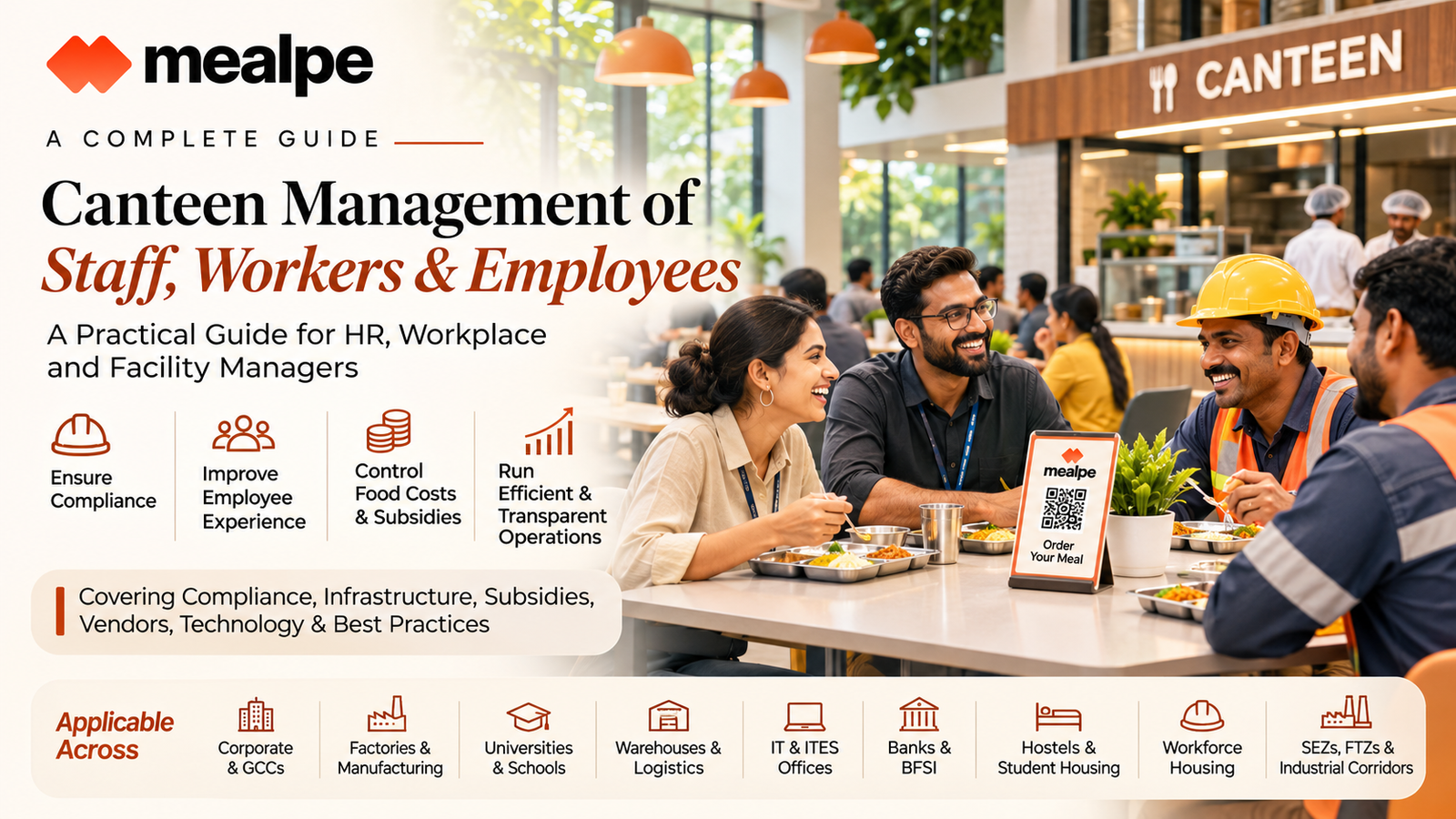
Employee canteen management is no longer simply about providing breakfast, lunch and dinner at the workplace. It is an integrated function involving employee welfare, food safety, statutory compliance, meal subsidies, catering operations, vendor management, financial accountability and workplace experience.
Whether you manage a corporate headquarters in Mumbai, a Global Capability Centre (GCC) in Bengaluru, a manufacturing facility in Ahmedabad, an IT campus in Hyderabad or a university in Gujarat, institutional food services demand operational discipline.
For HR Heads, Workplace Managers, Administration Teams and Facility Management Professionals, the challenge is straightforward:
How do you ensure that every eligible employee receives a safe, affordable and timely meal while maintaining transparency, operational efficiency and cost control?
This comprehensive guide explains the fundamentals of staff and worker canteen management, regulatory obligations in India, infrastructure planning, outsourcing, meal subsidies, digital transformation and how MealPe can support institutional food operations.
1. What Is Employee Canteen Management?
MealPe | Table of Contents
Employee canteen management refers to the systematic planning, administration, operation and monitoring of food services provided to employees, workers, contract labourers and other authorised individuals within an organisation. It includes kitchen operations, menu planning, workforce meal entitlements, vendor management, subsidy administration, consumption verification, food safety, billing and performance reporting.
Key Components of Employee Canteen Management
A professionally managed employee canteen generally involves eight interconnected functions:
- Meal Planning: Designing menus, meal calendars, portions and service schedules.
- Food Production: Managing kitchen operations, procurement, preparation and serving.
- Access Management: Determining who can consume subsidised or complimentary meals.
- Subsidy Management: Allocating employer contributions to employee meal expenses.
- Vendor Management: Supervising catering contractors and food-service providers.
- Food Safety: Maintaining hygiene, quality standards and statutory compliance.
- Financial Management: Monitoring consumption, billing, payments and food expenditure.
- Technology Management: Digitising meal ordering, verification, reconciliation and analytics.
Why Has Canteen Management Become an HR Priority?
A workplace canteen is a daily employee touchpoint.
Unlike many employee benefits used occasionally, workplace dining may be experienced several times throughout a working week.
Operational shortcomings can therefore generate recurring dissatisfaction.
Long queues, inconsistent food quality, limited menu choices, inaccurate subsidies and delayed service affect the employee experience.
Effective canteen management can support employee satisfaction, predictable shift schedules and organisational welfare objectives.
For employers, it also creates an opportunity to establish measurable accountability over a significant recurring operating expense.
2. Which Organisations Need Staff, Worker and Employee Canteen Management?
Institutional canteen management is relevant wherever substantial numbers of people work, study or reside within a shared facility. Although statutory obligations differ by establishment and jurisdiction, organisations across corporate, industrial, educational and residential sectors benefit from structured food-service management, accurate consumption records and centralised operational controls.
Industries and Establishments Where Canteen Management Is Applicable
| Establishment | Primary Canteen Management Requirement |
|---|---|
| Global Capability Centres (GCCs) | Employee dining, flexible subsidies, multiple meal options and workplace experience |
| Corporate Head Offices & HQs | Executive dining, employee meals, meetings and visitor ordering |
| Commercial Buildings | Shared food courts, tenant-specific billing and multiple vendors |
| Universities & College Campuses | Student messes, faculty dining, cafeteria ordering and meal plans |
| Schools & Academic Institutions | Scheduled meals, staff dining, boarding meals and hygiene supervision |
| Factories & Manufacturing Units | Shift-wise meals, statutory welfare facilities and contractor tracking |
| Warehouses & Stores | Affordable employee meals, shift timing and simple verification |
| Logistics Hubs & Fulfilment Centres | High-volume, staggered meals for a rotating workforce |
| IT & ITES Offices | Cashless cafeterias, late-shift meals, employee subsidies and ordering |
| Banks, BFSIs & Financial Campuses | Secure workplace dining, employee benefits and vendor governance |
| Hostels & Coliving Spaces | Subscription mess plans, attendance and resident meal management |
| Student Housing & Accommodations | Breakfast and dinner plans, resident eligibility and consumption reporting |
| Blue-Collar & Workforce Housing | Bulk meals, shift coordination, contractor billing and multilingual access |
| Ports & Transport Hubs | Extended service hours, transient users and high-volume meal distribution |
| SEZs, FTZs & Industrial Corridors | Multi-company workforce dining and institutional food-service infrastructure |
What Changes Across Different Industries?
The operating environment determines the appropriate service model.
Corporate offices often prioritise food variety, convenience and employee satisfaction.
Factories generally require speed, predictable meal volumes and disciplined entitlement management.
Universities need subscription-based mess management alongside cafeteria purchases.
Commercial buildings require tenant-wise reporting and independent vendor accounting.
Industrial campuses with thousands of workers may need a centralised kitchen supported by several distribution counters.
There is no universally appropriate canteen model. The right solution depends on workforce composition, operating hours, meal demand, location and commercial arrangements.
3. Is an Employee Canteen Mandatory Under Indian Labour Laws?
Canteen obligations in India depend on the applicable labour legislation, establishment classification, workforce strength and implementing rules. The Occupational Safety, Health and Working Conditions Code, 2020 provides for canteen facilities where 100 or more workers, including contract labourers, are ordinarily employed. Employers must also examine applicable Central or State rules.
Factories Act, 1948: The Historical Position
Section 46 of the Factories Act, 1948 empowered State Governments to require canteen facilities in specified factories ordinarily employing more than 250 workers.
State factory rules prescribed additional operating conditions concerning premises, seating, equipment, food quality, pricing, accounts and canteen management committees.
This explains why many older compliance publications refer to a 250-worker threshold.
However, treating that historical figure as the complete regulatory position in 2026 would be misleading.
Occupational Safety, Health and Working Conditions Code, 2020
India’s four Labour Codes came into force on November 21, 2025.
Section 24(1)(v) of the Occupational Safety, Health and Working Conditions Code, 2020 addresses canteen facilities in establishments ordinarily employing 100 or more workers, including contract labour.
The Code establishes the statutory framework, while applicable rules determine operational and implementation requirements.
Employers should verify whether their establishment falls within the relevant statutory definition, which government has jurisdiction, and which notified rules govern their particular location.
Responsibilities of HR and Facility Managers
A robust compliance process should identify:
- The establishment’s applicable statutory classification.
- Permanent employees and relevant contract labour.
- Actual and ordinarily employed workforce strength.
- Applicable Central or State implementing rules.
- Food-business licensing obligations.
- Building, fire, sanitation and local authority approvals.
- Workplace welfare and inspection requirements.
Maintaining a documented compliance register is particularly important for organisations operating across multiple states.
Official references: Ministry of Labour & Employment and India Code.
4. What Are the Infrastructure, Seating and Dining Hall Requirements for Factory Canteens?
Factory canteen infrastructure must be planned around the applicable building, sanitation, food-safety and labour requirements. Relevant standards can cover location, dining capacity, usable floor area, kitchen separation, ventilation, washing facilities and worker amenities. Dimensions found in historical State Factory Rules should not automatically be treated as uniform national requirements.
Dining Hall Capacity and Space Planning
The Gujarat Factories Rules, 1963 provide a useful historical example of detailed canteen infrastructure standards.
Rule 73 specifies dining accommodation for at least 30% of workers working at a time and a minimum dining floor area of 0.9 square metres per diner, subject to its provisions.
Illustrative calculation:
Consider a manufacturing plant with 600 workers in its largest operating shift.
| Parameter | Calculation |
|---|---|
| Workers in the relevant shift | 600 |
| Dining accommodation at 30% | 180 diners |
| Dining floor area at 0.9 m² per diner | 162 m² |
| Additional kitchen, storage and utility areas | Calculated separately |
This example illustrates the cited Gujarat rule, not a universal requirement applicable to every modern establishment.
Location and Boundary Considerations
Historical Gujarat factory canteen provisions include a separation distance of 15.2 metres from specified contamination sources, subject to permitted relaxations.
These sources include latrines, urinals, boiler houses, coal stacks, ash dumps and other sources of dust, smoke or objectionable fumes.
Mandatory Functional Areas
A purpose-designed canteen may include:
- Dining hall and meal-service counters.
- Food preparation and cooking kitchen.
- Dry and refrigerated storage areas.
- Pantry and ingredient preparation area.
- Separate washing arrangements for workers and utensils.
- Waste collection and disposal facilities.
- Handwashing and drinking-water points.
The layout should separate clean food preparation from dirty equipment and waste movement.
Construction, Ventilation and Hygiene
Surfaces should be easy to clean, structurally sound and suitable for food operations.
Under the cited Gujarat provisions, inside walls up to 1.2 metres require smooth, impervious material, while doors and windows must provide fly protection and adequate ventilation.
Kitchen exhaust, lighting, drainage and safe flooring are essential considerations.
Important: The 3.65-metre roof-height figure sometimes reproduced in canteen infographics should not be assumed to be a universal canteen-building rule. Applicable building and welfare-facility provisions must be checked separately.
Before approving a canteen layout, obtain a state-specific compliance assessment from a qualified professional.
5. What FSSAI Licences and Food Safety Standards Apply to Workplace Canteens?
Workplace canteens handling food must operate within India’s food-safety framework, including applicable FSSAI registration or licensing requirements and hygienic food-handling standards. The responsible Food Business Operator must be identified, licensed or registered as required, and supported by documented food-safety procedures, trained personnel and inspection-ready operational records.
FSSAI Registration and Licensing Requirements in 2026
The Food Safety and Standards Authority of India revised the general turnover thresholds effective April 1, 2026.
| Annual Turnover | General FSSAI Category |
|---|---|
| Up to ₹1.5 crore | Registration |
| Above ₹1.5 crore to ₹50 crore | State Licence |
| Above ₹50 crore | Central Licence |
The precise category may also depend on the nature, scale and location of the food business or other activity-specific criteria.
Organisations should confirm the appropriate category through FoSCoS.
Schedule 4 Food Hygiene Requirements
FSSAI Schedule 4 covers hygienic and sanitary practices, including requirements relevant to catering establishments.
Operational controls should cover:
Food Procurement: Purchase from suitable suppliers, inspect deliveries and maintain traceability.
Storage: Separate raw and cooked foods, prevent contamination and maintain appropriate storage conditions.
Food Preparation: Use hygienic preparation methods, clean equipment and controlled cooking processes.
Food Handling: Enforce personal hygiene, handwashing and appropriate protective clothing.
Cleaning: Maintain documented cleaning and sanitisation schedules.
Pest Control: Implement preventive inspections and corrective measures.
Water Safety: Ensure potable water and appropriate testing.
Waste Management: Segregate waste, maintain covered receptacles and arrange hygienic disposal.
Food Handler Training and Medical Fitness
Food-service personnel should receive appropriate hygiene training and medical fitness assessments under the applicable requirements.
FSSAI’s FoSTaC programme provides food-safety training for relevant food-business personnel.
Facilities should preserve records of training, inspections, corrective actions and staff fitness assessments as applicable.
The goal is not merely to pass an inspection. It is to prevent unsafe food from reaching employees.
6. What Are the Different Employee Canteen Operating Models?
Employee canteens generally operate through in-house management, outsourced catering contracts, management contracts or multi-vendor cafeteria arrangements. Each model distributes responsibility for staffing, infrastructure, procurement, quality control and financial performance differently. Selecting the appropriate operating structure depends on facility scale, management capability, budget and required service flexibility.
Major Canteen Operating Models
| Model | How It Works | Suitable For |
|---|---|---|
| In-House Canteen | Organisation employs and supervises food-service personnel | Large institutions with established operational teams |
| Outsourced Catering | External contractor prepares and serves meals | Factories, offices and industrial campuses |
| Management Contract | Specialist manages operations under agreed commercial terms | Large campuses and institutional kitchens |
| Multi-Vendor Cafeteria | Several vendors operate within a common food court | GCCs, IT parks and commercial buildings |
| Central Kitchen & Distribution | Meals prepared centrally and supplied to multiple counters | Logistics hubs and industrial clusters |
| Hybrid Model | Fixed subsidised meals combined with paid cafeteria outlets | Corporate campuses, universities and mixed-use premises |
Which Model Is Most Appropriate?
A factory providing fixed meals to 2,000 workers may prioritise a managed kitchen and verified consumption system.
A GCC accommodating 800 professionals may prefer multiple food brands and flexible allowances.
A residential university might combine a prepaid mess subscription with independent food-court ordering.
The distinction matters because food-service outsourcing and canteen management software solve different problems.
A caterer prepares and serves food.
A digital management platform coordinates eligibility, ordering, consumption, payments and reporting.
In a mature operating environment, both functions work together.
7. How Should HR and Facility Managers Plan a New Canteen?
A successful canteen launch starts with workforce demand assessment rather than kitchen construction. HR and Facility Managers must estimate meal participation, peak-hour capacity, shift schedules, menu requirements, subsidies, infrastructure, vendor responsibilities and operating costs before selecting contractors or technology. The resulting plan should establish clear service and financial accountability.
Step 1: Understand Your Workforce
Collect data on employee strength, contract labour, shifts, working days, attendance and expected meal participation.
Also consider employee preferences, religious or dietary restrictions, affordability and anticipated growth.
Step 2: Forecast Meal Demand
Estimate demand separately for breakfast, lunch, dinner and other approved meal periods.
Do not assume every employee eats every meal on-site.
Demand forecasting should account for remote work, weekly offs, leave, shift variations and seasonal changes.
Step 3: Determine Service Capacity
Evaluate serving counters, dining seats, food preparation capacity and available meal-break windows.
Peak-hour planning is more relevant than average daily consumption alone.
Step 4: Establish the Commercial Structure
Decide who pays for meals, how subsidies work, whether vendors receive fixed fees or per-meal payments and how consumption is verified.
Step 5: Document Standard Operating Procedures
Define operating instructions for procurement, kitchen hygiene, portion control, serving, payments, complaints, emergencies and reporting.
Step 6: Establish Governance
Assign responsibilities to HR, Facilities, Finance, Procurement, EHS and the food-service provider.
Where legally applicable, establish the required worker representation and canteen managing committee.
8. How Do You Manage Permanent Employees and Contract Workers in One Canteen?
A unified canteen can serve permanent employees, contractual staff, temporary workers, trainees and authorised visitors while applying different meal entitlements and billing rules. Effective workforce canteen management requires a reliable employee database, contractor mapping, shift eligibility, transaction records and separate financial reporting without creating unnecessary complexity for diners.
Why Workforce Classification Matters
Consider a manufacturing unit with:
- 700 permanent employees.
- 900 contractor workers.
- 150 trainees and apprentices.
- 50 administrative and support personnel.
Each group may have different meal subsidies, eligibility rules and payment arrangements.
If all meals are distributed through undifferentiated paper tokens, the employer may struggle to determine which department or contractor should bear the expense.
Contractor-Wise Meal Management
An effective system should associate each contractor worker with an approved contractor, active engagement period, assigned shift and applicable meal entitlement.
When an engagement ends, eligibility should be updated promptly.
Facilities and Finance should reconcile meal records against the relevant contractor’s invoices and approved contractual terms.
Preventing Proxy Meals
QR verification, RFID cards, authenticated employee credentials and appropriate biometric systems can help prevent unauthorised redemption.
However, no identification method is completely fraud-proof.
Proper controls also require transaction limits, exception approvals, duplicate-use detection and audit trails.
Where biometric verification is considered, employers must assess applicable data-protection requirements and offer proportionate alternatives when appropriate.
9. How Should Organisations Structure Employee Meal Subsidies?
Employee meal subsidies determine how food costs are shared between employers and their workforce. A well-designed subsidy policy defines who is eligible, the employer contribution, employee payment, meal limits, permitted outlets and accounting treatment. Digital systems can enforce these rules consistently while providing financial transparency and reliable consumption records.
Common Corporate Meal Subsidy Models
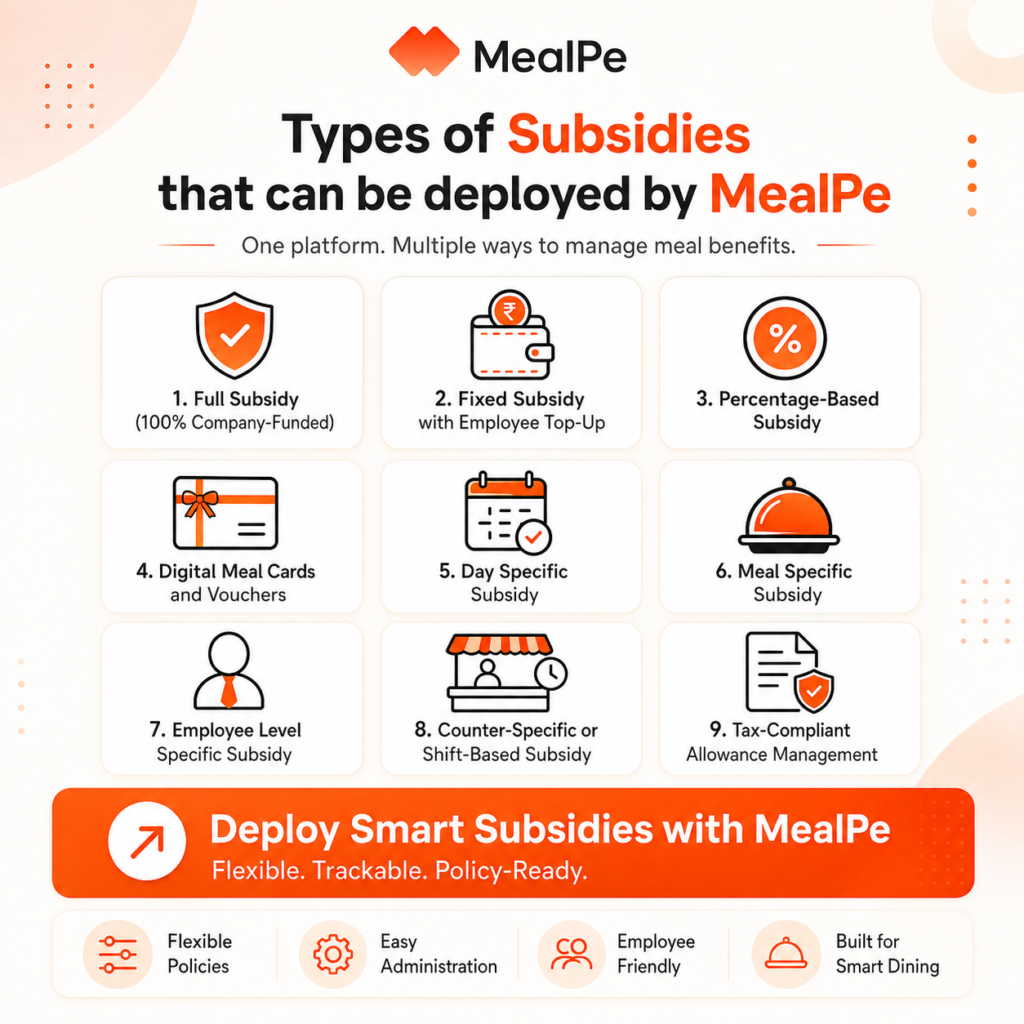
| Subsidy Model | Example | Typical Application |
|---|---|---|
| Fully Subsidised | Employer pays the entire eligible meal cost | Manufacturing, industrial welfare programmes |
| Fixed Subsidy | Employer contributes ₹50 against an ₹80 meal | Corporate offices |
| Percentage Subsidy | Employer pays 60% of the eligible bill | GCCs and IT campuses |
| Monthly Meal Allowance | Employee receives ₹2,000 monthly allowance | Offices and BFSIs |
| Grade-Based Subsidy | Benefits differ by approved employee category | Large enterprises |
| Shift-Based Subsidy | Entitlement changes by work shift | Factories and logistics hubs |
| Category-Based Subsidy | Subsidy applies only to selected menu categories | Corporate cafeterias |
| Contractor-Specific Subsidy | Different contractor agreements define meal liability | Industrial facilities |
The examples are illustrative, not statutory subsidy amounts.
Managing Subsidy Leakage
Subsidy leakage occurs when organisations fund meals outside the approved entitlement policy.
Potential causes include duplicate redemption, inactive employees retaining access, incorrect subsidy configuration, unauthorised guest consumption and unverified vendor bills.
Controls should include eligibility checks, user-level limits, approval workflows and regular reconciliation.
Payroll and HRMS Integration
Canteen deductions, where lawfully authorised, may be processed through approved payroll workflows.
HRMS integration can also synchronise employee onboarding, termination, department changes and contractor allocation.
Payroll deductions must comply with applicable wage legislation, employment arrangements and consent or authorisation requirements.
10. How Can Organisations Improve Menu Planning, Nutrition and Food Quality?
Institutional menu planning must balance nutrition, employee preferences, affordability, kitchen capacity and predictable food consumption. A strong menu programme uses rotating meal calendars, portion standards, dietary information, feedback mechanisms and regular quality reviews. The objective is to deliver consistent meals that employees actually want to consume.
Menu Planning for Different Workforces
Industrial Workers: Menus should reflect physical work demands, shift schedules, affordability and adequate nutritional provision.
Corporate Employees: Offer variety, balanced options, convenient ordering and clear menu information.
Students: Combine predictable meal plans with age-appropriate nutrition and institutional dietary policies.
GCC Professionals: Provide diverse meal choices reflecting employee demographics and workplace preferences.
Dietary Preferences and Accessibility
Common considerations include vegetarian, Jain, regional, high-protein, lower-sugar and medically prescribed dietary requirements.
Allergen information should be accurate and supported by appropriate food-handling controls.
Menus should also consider employees observing fasting practices or religious dietary restrictions.
Food Quality Monitoring
Daily monitoring should include visual inspection, ingredient acceptance, portion consistency, hygienic service and appropriate food-temperature records.
Feedback should be analysed by meal, outlet, time and complaint category.
Repeated quality failures require corrective action rather than simply changing the following week’s menu.
11. How Do You Select and Manage a Corporate Canteen Contractor?
Selecting a canteen contractor requires assessment of operational capability, food safety, staffing, financial stability, scalability and contractual accountability. Procurement teams should evaluate more than quoted meal prices, because inexpensive contracts can become costly when poor quality, service failures, food waste and weak billing controls are taken into account.
Vendor Selection Criteria
| Evaluation Area | What to Verify |
|---|---|
| Food Safety | Applicable FSSAI credentials, hygiene procedures and training records |
| Operating Experience | Relevant experience at similar institutional volumes |
| Kitchen Capability | Production infrastructure, equipment and service capacity |
| Manpower | Staffing plan, supervision and applicable labour compliance |
| Commercial Proposal | Transparent pricing and clearly defined inclusions |
| Technology | Compatibility with digital ordering and consumption tracking |
| Business Continuity | Backup kitchens, emergency sourcing and contingency plans |
| Financial Stability | Ability to sustain operations and meet contractual obligations |
| References | Verifiable institutional client references |
Essential Canteen Contract Clauses
Contracts should clearly address meal specifications, pricing, operating hours, statutory responsibilities, food safety, insurance, staff deployment, audit rights, complaint resolution and termination procedures.
Commercial terms should identify the billable event.
For example, is the contractor paid for meals ordered, meals prepared, meals dispatched or verified meals served?
These definitions must be agreed before operations begin.
Service Level Agreements
Appropriate service-level indicators may include on-time availability, queue performance, hygiene audit results, complaint resolution, food quality and reporting accuracy.
Penalties should be proportionate, enforceable and linked to clearly defined performance failures.
12. What Features Should Modern Canteen Management Software Include?
Modern canteen management software connects meal entitlements, digital ordering, identity verification, payments, kitchen workflows, vendor settlements and management reporting. Its primary purpose is to replace fragmented manual processes with consistent, auditable data. Enterprise deployments should also provide suitable integrations, permissions, privacy safeguards and operational continuity during connectivity failures.
Essential Capabilities of an Enterprise Canteen System
Employee Identity and Access: Verified employee or resident profiles linked to approved meal entitlements.
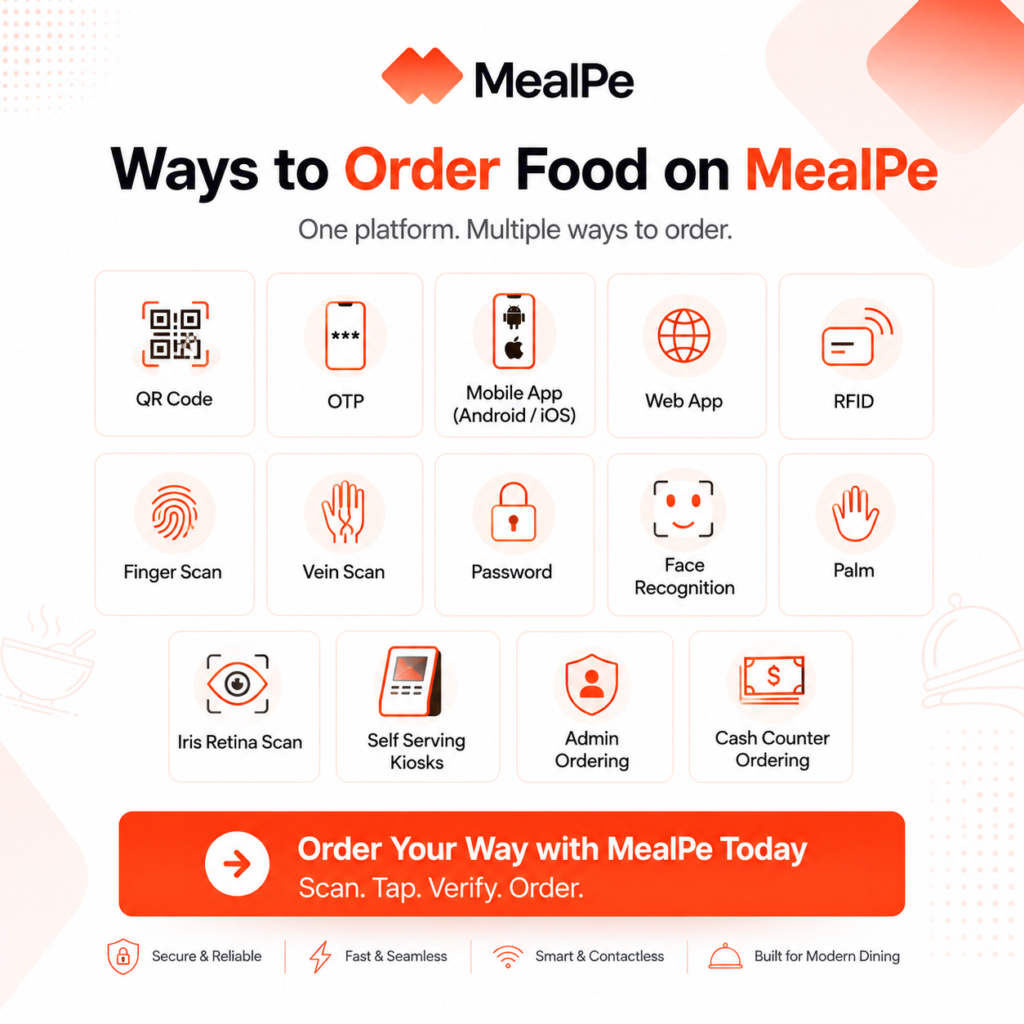
Multiple Ordering Channels: Mobile applications, web ordering, QR codes, kiosks and attended counters.
Meal Scheduling: Breakfast, lunch, dinner and configurable shift-wise meal windows.
Subsidy Rules: Employer-funded, partially subsidised and category-specific benefits.
Vendor Management: Outlet-wise menus, payments, kitchen orders and settlement reporting.
Consumption Analytics: Expected demand, actual redemptions and unused meal entitlements.
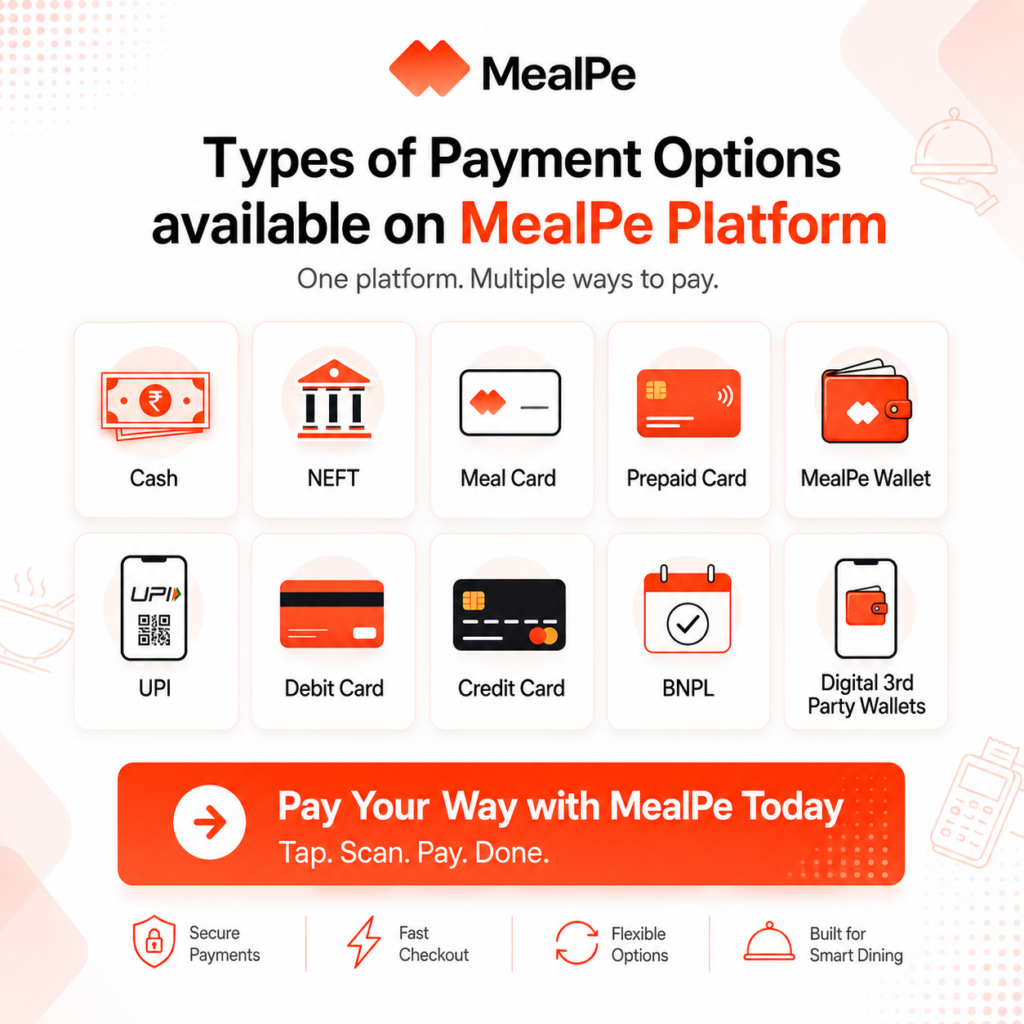
Cashless Payments: Support for appropriate UPI, cards, wallets and institutional prepaid arrangements.
Enterprise Reporting: Department-wise, contractor-wise, shift-wise and location-wise MIS.
Why Integration Matters
Many organisations already operate HRMS, ERP, payroll, attendance and accounting software.
A canteen platform should exchange relevant information with these systems through approved APIs, file transfers or other supported interfaces.
A central employee database reduces duplicate records and inconsistent benefit allocations.
Enterprise Data Security
Important safeguards include role-based access, authentication, audit logging, data minimisation and defined retention periods.
Employee dining records are organisational data and should not be collected or used without a legitimate, documented purpose.
The use of biometric identifiers deserves additional legal, privacy and security evaluation.
13. How Can Canteen Managers Reduce Queues, Food Waste and Operational Inefficiencies?
Canteen efficiency improves when meal demand, preparation volumes and service capacity are coordinated using reliable data. Pre-ordering, RSVP meal confirmation, staggered breaks, verified meal collection and real-time kitchen reporting can reduce uncertainty. Their effectiveness depends on implementation quality, employee adoption and the operating discipline of food-service vendors.
Reducing Peak-Hour Queues
Long queues often emerge when employees arrive simultaneously and ordering begins only at the counter.
Potential improvements include advance meal ordering, scheduled collection windows, additional serving counters and separate flows for fixed meals and à la carte orders.
Improving Demand Forecasting
A traditional kitchen may prepare meals according to expected attendance without knowing actual participation.
A digital RSVP process allows employees to confirm intended consumption before an agreed cut-off.
Kitchen teams can use this information alongside historical consumption patterns to refine production quantities.
Reducing Food Wastage
Food waste should be measured at several stages:
- Production waste.
- Storage and spoilage losses.
- Unserved prepared food.
- Plate waste after serving.
These categories require different corrective actions.
Lower production waste may depend on improved forecasting, while plate waste may indicate excessive portions or dissatisfaction with a particular dish.
14. How Much Does Employee Canteen Management Cost?
Employee canteen cost depends on the number of meals served, menu composition, labour, kitchen infrastructure, utilities, procurement and contract structure. HR and Finance should assess both the meal’s variable cost and the full operating expenditure. Subsidy decisions must then be evaluated against actual consumption and the approved employee benefit policy.
Illustrative Monthly Canteen Cost Calculation
Consider a corporate facility with 800 employees.
| Parameter | Assumption |
|---|---|
| Total employees | 800 |
| Average daily meal participation | 70% |
| Operating days per month | 22 |
| Meals per day | 560 |
| Monthly meals served | 12,320 |
| Assumed contracted price per meal | ₹80 |
| Monthly meal expenditure | ₹9,85,600 |
| Employer subsidy per meal | ₹50 |
| Employer subsidy expenditure | ₹6,16,000 |
| Employee contribution per meal | ₹30 |
| Monthly employee contributions | ₹3,69,600 |
This is an illustrative financial model. Taxes, separate fixed fees, infrastructure costs and other contractual expenses are excluded.
Understanding Total Cost of Ownership
The complete canteen budget may include food ingredients, vendor service charges, kitchen staffing, equipment, maintenance, electricity, water, cleaning, waste disposal and software expenses.
When required under applicable statutory rules, specific costs may need to be borne by the employer rather than recovered through food prices.
Measuring Financial Efficiency
A useful management metric is:
Effective employer canteen cost per verified meal = Total attributable employer expenditure ÷ Verified meals served.
This measure allows management to examine expense trends without assuming that lower spending necessarily indicates better food-service quality.
15. Which KPIs Should HR and Facility Managers Track?
Canteen performance should be evaluated through a balanced scorecard covering service availability, employee satisfaction, food safety, financial control and operational productivity. Measuring food cost alone overlooks important service outcomes. Managers need reliable indicators that reveal whether employees receive meals efficiently, safely and within approved budgets.
Recommended Canteen Management KPIs
| KPI | Measurement |
|---|---|
| Meal Participation Rate | Verified diners ÷ eligible population |
| Subsidy Utilisation | Subsidy consumed ÷ allocated subsidy |
| Average Queue Time | Time between joining and completing service |
| Meal Forecast Accuracy | Comparison of forecast and actual consumption |
| Food Waste Percentage | Measured waste relative to relevant production |
| Cost Per Verified Meal | Attributable expenditure ÷ verified meals |
| Complaint Rate | Valid complaints per 1,000 meals |
| Complaint Resolution Time | Time required for corrective action |
| Vendor SLA Compliance | Fulfilled service commitments ÷ measured commitments |
| Meal Verification Exceptions | Flagged or manually approved transactions |
| Employee Satisfaction | Feedback ratings and survey trends |
| Hygiene Compliance | Audit observations and closure performance |
Building an Executive Dashboard
HR should primarily monitor satisfaction and welfare outcomes.
Facility Management should focus on daily service execution.
Finance requires accurate subsidies, expenditure and vendor settlement information.
Procurement needs evidence of contractual performance.
A consolidated dashboard can support these stakeholders without requiring separate manually prepared reports.
16. What Is the Role of Canteen Managing Committees and Employee Feedback?
Canteen governance should create a formal mechanism for employee representation, food quality review, menu decisions, complaints and management accountability. Where applicable labour rules require a canteen managing committee, its composition and procedures must follow those rules. Elsewhere, an internal food-service committee can provide structured employee consultation.
Canteen Managing Committee Responsibilities
Typical responsibilities include reviewing food quality, portion sizes, meal timings, menus, prices and recurring employee concerns.
The historical Gujarat Factories Rules provide for employer and worker representation in relevant canteen managing committees.
Such provisions should be checked against the currently applicable legal framework.
Making Employee Feedback Useful
Feedback collection should be accessible through multiple channels, including QR surveys, digital ratings, suggestion registers and scheduled employee meetings.
Complaints should be classified into categories such as hygiene, taste, quantity, pricing, delays and staff conduct.
Managers should track corrective actions and communicate meaningful improvements.
The purpose of feedback is not simply to generate satisfaction scores. It is to improve the service employees receive.
17. How Should GCCs and Corporate Offices Manage Employee Dining Experiences?
Global Capability Centres and corporate offices increasingly treat workplace dining as part of employee experience and workplace operations. Their canteens must accommodate diverse food preferences, flexible attendance, multiple vendors, cashless transactions and changing meal demand. Management priorities often differ from fixed-meal industrial canteens, requiring a more flexible commercial and operational design.
Workplace Dining for GCCs
GCC environments may include hybrid attendance, flexible working schedules, visiting international teams and different departmental meal policies.
These conditions favour digital ordering, multiple vendors, meal allowances and transparent employee-level consumption reporting.
Managing Multi-Vendor Food Courts
A shared cafeteria can host several independent food-service operators.
Without centralised systems, vendors may use separate payment arrangements, inconsistent reporting methods and different order-handling processes.
A common platform can provide coordinated ordering, menu visibility and reporting while preserving vendor-level financial records.
Employee Experience and Retention
Workplace dining should be assessed for convenience, reliability, inclusion and value.
Dining can also support interaction between teams and reduce the need for employees to leave the workplace for every meal.
However, productivity or retention improvements should be measured using organisation-specific evidence rather than assumed from cafeteria software deployment alone.
18. How Can MealPe Help Organisations Digitise Employee and Worker Canteen Management?
MealPe provides an institutional food-service technology platform covering digital cafeterias, mess management, ordering, verification, billing and analytics. Its product suite supports different operating environments, from multi-vendor corporate food courts to fixed-meal industrial kitchens. Organisations can evaluate the relevant modules according to their workforce, meal policies, vendor structure and integration needs.
MealPe Digital Cafeteria: For Corporate Offices and GCCs
MealPe Digital Cafeteria is designed for institutions operating cafeterias and food courts.
Its published capabilities include:
- Mobile, web and QR-based ordering.
- Cashless payments and institutional wallets.
- Multi-vendor menu and outlet management.
- Point-of-sale and counter billing.
- Kitchen Order Ticket (KOT) generation.
- Kitchen display and order-routing workflows.
- Sales analytics and management reporting.
- Integration options for enterprise software.
This makes Digital Cafeteria relevant to corporate headquarters, IT parks, GCCs, commercial buildings and university food courts.
MealPe Mess Manager: For Fixed Employee Meals
MealPe Mess Manager supports organisations offering fixed or subscription-based meals.
Its documented capabilities include meal schedules, RSVP confirmation, identity verification, consumption tracking, subscription billing and analytics.
Potential use cases include employee messes, factory canteens, student residences and workforce housing.
MealPe supports QR, RFID and biometric verification options, alongside administrative workflows for exceptional cases.
MealPe for Factories and Industrial Campuses
MealPe’s factory workforce solution specifically addresses shift-wise meal eligibility, contractor mapping and consumption reporting.
A factory can configure eligible meal windows and associate workers with contractor records to support accurate billing.
Prepaid meal cards also provide an option for environments where not every worker uses a smartphone.
How MealPe Supports Different Stakeholders
| Stakeholder | Relevant MealPe Capability |
|---|---|
| HR Manager | Employee benefits and meal entitlement administration |
| Facility Manager | Meal operations and consumption monitoring |
| Finance Manager | Transaction reports and settlement information |
| Procurement Manager | Vendor-level reporting and commercial reconciliation |
| Factory HR | Shift-wise eligibility and contractor meal mapping |
| Cafeteria Vendor | Orders, menus, billing and kitchen workflows |
| Employees & Workers | Convenient ordering or authorised meal verification |
| Campus Administrator | Fixed meal plans and institutional reporting |
One Platform, Multiple Institutional Dining Formats
MealPe’s platform approach allows institutions to evaluate digital cafeteria and mess-management solutions within a broader food-service technology ecosystem.
Specific integration scope, subsidy configurations, hardware compatibility and implementation requirements should be confirmed during solution design.
Explore: MealPe Corporate Cafeteria Solutions or Request a MealPe Demo.
19. How Can Organisations Implement Digital Canteen Management in 90 Days?
Digital canteen implementation should follow a phased approach that validates workforce records, operational workflows and financial controls before full deployment. A structured 90-day rollout can cover assessment, configuration, pilot operations and optimisation, provided infrastructure and integrations are ready. Complex multi-location implementations may require a longer programme.
Days 1–15: Assessment and Process Mapping
Map employee categories, contractor populations, meal timings, current vendors and subsidies.
Document existing pain points, compliance gaps and reporting requirements.
Identify the stakeholders responsible for approving policies and validating outcomes.
Days 16–30: Solution Configuration
Configure meal plans, user roles, access methods, vendors, payment arrangements and reporting structures.
Review potential HRMS, payroll and accounting integrations.
Prepare employee communication and training materials.
Days 31–60: Controlled Pilot
Run a limited deployment covering selected departments, employee categories or meal shifts.
Compare verified transactions with vendor records.
Test unusual scenarios, including missing cards, network outages, late arrivals and entitlement changes.
Days 61–90: Rollout and Optimisation
Expand the deployment after resolving operational issues.
Train supervisors, vendors and administrative users.
Establish daily, weekly and monthly management reporting.
Review the first settlement cycle and adjust operating procedures using actual transaction data.
20. What Should Be Included in a Canteen Management Audit Checklist?
A canteen audit should cover statutory applicability, food safety, infrastructure, employee welfare, contractor governance, financial transactions and operational performance. A comprehensive checklist helps HR, EHS, Facilities and Procurement identify control gaps before they become significant compliance or service problems. Audit findings should have documented owners, deadlines and closure evidence.
Employee Canteen Management Checklist
- Applicable labour law and State rules reviewed.
- FSSAI registration or licence verified.
- Required building and operational approvals reviewed.
- Kitchen hygiene and pest-control procedures documented.
- Potable water arrangements verified.
- Food-handler training and medical records maintained as required.
- Kitchen, dining and washing areas inspected.
- Meal pricing and subsidy policy approved.
- Permanent and contractor worker eligibility defined.
- Vendor contracts and applicable SLAs reviewed.
- Daily meal counts independently reconcilable.
- Canteen committee requirements evaluated.
- Employee complaint escalation process operational.
- Food waste and expenditure monitored.
- Contingency arrangements documented.
- Access controls, privacy and reporting permissions reviewed.
An effective audit programme also verifies whether previously reported issues were actually corrected.
21. Frequently Asked Questions About Employee Canteen Management in India
Employee canteen management raises recurring questions about statutory obligations, subsidy administration, outsourcing, software, food safety and contractor billing. The following answers address common decisions faced by HR Heads, Workplace Managers and Facility Management Teams. Exact legal requirements depend on establishment classification, location and applicable implementing rules.
FAQ 1. Is providing a canteen mandatory for companies in India?
Canteen obligations depend on the establishment and applicable labour rules. The OSH Code, 2020 provides for canteen facilities in establishments ordinarily employing 100 or more workers, including contract labour, subject to the applicable legal framework. Organisations should verify current Central or State implementing rules rather than relying exclusively on the historical Factories Act threshold.
FAQ 2. What is the difference between canteen management and cafeteria management?
Canteen management commonly refers to organised meals for employees or workers, often involving fixed menus, subsidised rates and eligibility controls. Cafeteria management frequently involves individual menu selections, multiple vendors and pay-per-order transactions. Both require food safety, procurement, payment and operational governance. Many institutions operate hybrid models combining both approaches.
FAQ 3. Can a company outsource its employee canteen operations?
Yes. Organisations may engage external catering contractors, institutional food-service providers or management companies, subject to applicable statutory requirements. Outsourcing does not automatically eliminate the employer’s legal responsibilities. Contracts should clearly allocate food-safety obligations, staffing, payment arrangements, performance monitoring and regulatory responsibilities while preserving appropriate employer oversight.
FAQ 4. What is the best way to manage employee meal subsidies?
The most appropriate method is a documented subsidy policy supported by reliable consumption records. Employers should define eligibility, contribution limits, meal categories and settlement procedures. Digital canteen systems can apply approved rules at the transaction level and generate reports for HR and Finance, reducing manual processing and improving reconciliation.
FAQ 5. How can factories manage meals for contract labour?
Factories can maintain contractor-wise worker records, approved meal entitlements and shift-based verification. Each verified meal can then be associated with the appropriate contractor or cost centre. This supports transparent invoicing, employer subsidy accounting and workforce reporting. Accurate onboarding and deactivation of temporary workers are essential to maintaining reliable records.
FAQ 6. What are the essential features of employee canteen management software?
Important features include meal eligibility, QR or card-based verification, digital ordering, subsidy controls, consumption analytics, vendor reporting, payment management and enterprise integration options. Industrial facilities may additionally require shift mapping and contractor billing. Corporate environments may prioritise multi-vendor operations, flexible meal allowances and employee-facing ordering.
FAQ 7. How does digital canteen management reduce food waste?
Digital systems can capture meal confirmations, historical participation, expected demand and actual consumption. Kitchen managers can use these records to refine preparation quantities and identify demand variations. Waste reduction also depends on portion management, menu acceptance, storage practices and disciplined production planning. Technology provides visibility; operational decisions create the savings.
FAQ 8. Can MealPe manage corporate cafeterias and industrial worker canteens?
MealPe offers Digital Cafeteria and Mess Manager solutions for different institutional food-service requirements. Its published capabilities include digital ordering, meal scheduling, access verification, multi-vendor management, billing and analytics. For industrial environments, MealPe also describes shift-based eligibility and contractor meal mapping. Organisations should confirm specific configurations and integrations through a product demonstration.
22. Conclusion: Why Is Professional Employee Canteen Management Important?
Professional canteen management brings together employee welfare, statutory compliance, food safety, operational efficiency and financial accountability. For modern organisations, managing meals effectively requires more than selecting a caterer. It requires an accountable operating framework supported by reliable processes, appropriate technology, trained personnel and continuous performance monitoring.
From corporate headquarters and GCCs to factories, industrial parks, universities and workforce housing, the requirements differ, but the management principles remain consistent.
Employees expect safe, affordable and convenient meals.
HR teams expect welfare outcomes and policy consistency.
Facility Managers expect reliable service delivery.
Finance teams expect accurate expenditure and transparent reconciliation.
The most effective institutional canteens align all four expectations.
Transform Your Employee Canteen with MealPe
Still managing employee meal consumption through manual registers, paper tokens, disconnected billing systems or vendor-generated spreadsheets?
MealPe helps institutions digitise ordering, meal verification, consumption monitoring, billing and cafeteria management.
Explore solutions for corporate cafeterias, manufacturing plants, institutional kitchens and workforce meal programmes.
Request a Product Demonstration
MealPe — The Operating System for Institutional Food Services.
Authoritative References and Further Reading
- Ministry of Labour & Employment, Government of India — Labour Codes and workplace welfare.
- India Code — Central labour legislation, including the Factories Act, 1948 and OSH Code, 2020.
- Food Safety and Standards Authority of India — Food-business registration, licensing and regulatory guidance.
- FSSAI FoSCoS — Food Safety Compliance System.
- FSSAI FoSTaC — Food safety training and certification.
- MealPe — Institutional cafeteria and mess management technology.
Regulatory disclaimer: This publication provides general operational and regulatory information as of November 2026. Labour-law implementation, State-specific infrastructure provisions, licensing classifications and other requirements should be independently verified for each establishment. This article does not substitute for professional legal, food-safety or building-compliance advice.